
Mechanic Shifting VS Wireless Shifting – What We Learnt
Many cyclists, especially in the road and gravel biking scene, have questioned which is better between mechanical and wireless shifting or at least if there’s a benefit to wireless at all. Anthony, our marketer and tester, identified the differences and even found benefits between the two.
If you are looking for an upgrade, either to wireless or from one manufacturer to another, get in touch! Contact Us
The Groupsets Being Compared
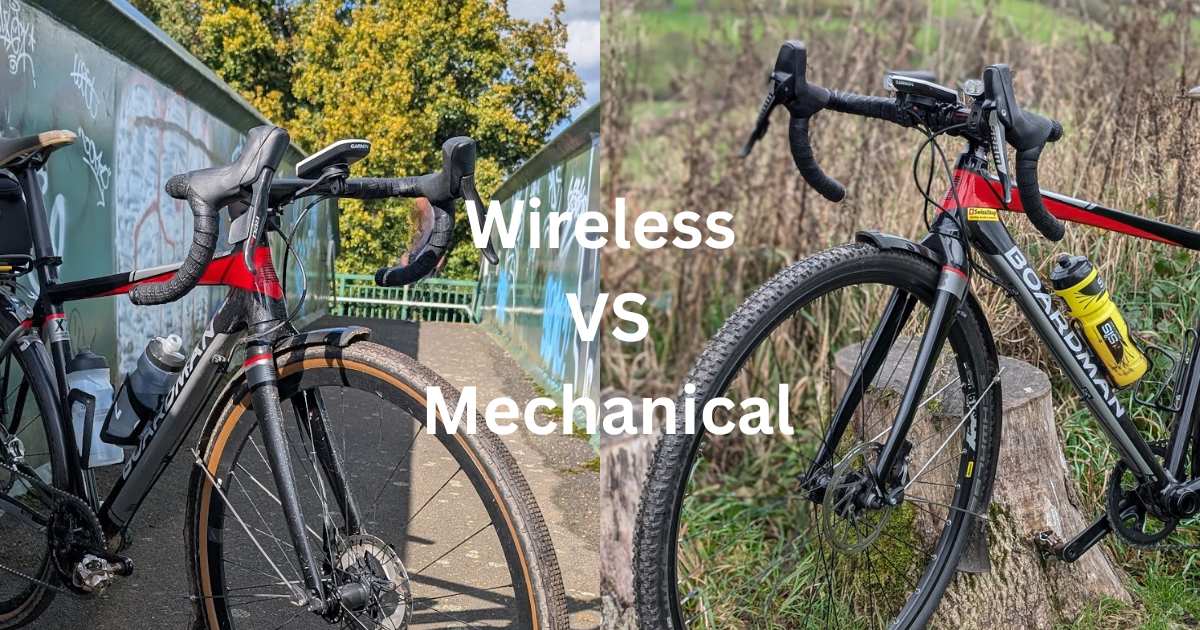
Anthony has been comparing the SRAM Rival mechanical and SRAM Red wireless on his 1x gravel bike.
One key note here is that the Red rear derailleur being used is a short-cage and therefore cannot stretch across each sprocket on the cassette as the max reach is 35t. Being 1x (one by), meaning no front derailleur and only one chain ring, does mean the rear cassette ranges from 11t up to 45t. For you cycling nerds, his chain ring is a 44t.
SRAM Rival Mechanical

Like all SRAM gears, these have the ‘Double Tap’ system, which simply means one click of the gear lever to go up, and two clicks to go down a gear. On Shimano, this would mean clicking the gear lever to go up and pulling the brake lever over to move down. These differences are typically one key aspect of whether someone prefers SRAM or Shimano. Here at Mondo’s… we are certainly a SRAM family.
The Rival levers have a slightly taller and more square hood shape, which makes for a good, comfortable grip. Again, being 1x, only the right side lever has a gear shifter. Like most mechanical gears, you can feel and connect with each gear shift, providing you with confidence that the move up or down was successful.
When getting covered in dirt and mud, Anthony’s gravel bike would continue working with no issues; however, at times, he would struggle finding the time to select the right gear – this could be either mechanical reasons or a lack of gravelling experience.
The only time the mechanical gears had issues was when the cable would snag at the tight bend of the original Boardman handlebars, but this was sorted with a slinky outer cable inserted at the bend.
Now. There is also a party piece for those sprinters out there… Should you be on the drops ready for a sprint, you can pull down the gear lever, so you hold it as you hold the drops. This means you can change gears with a little movement whilst in sprint mode. Of course, you can’t do this with Shimano as the STI system is linked to the brake lever.
SRAM Red Wireless

The obvious things to keep in mind when running wireless are;
- Keep it charged
- Check your shifter batteries.
- Carry a spare battery with you.
Initially, Anthony thought nothing incredible about the switch, but as soon as he went off-road, that changed. Where he would previously struggle to find the right time to change up or down gears when riding a technical section of a gravel track, he now does so with ease. Yes, his experience by this point has grown, but the shifting is now effortless.
With SRAM wireless, you use the left lever to change down a gear and the right lever to move up, removing the extra effort needed with the ‘Double Tap’. This means when you need a lower gear at a moment’s notice, it is like pressing a simple button, and it responds instantly.
His bike would also have to get extremely muddy to see any issue in the drive chain and shifting, as we no longer have a gear cable, which in this case runs along the underside of the frame externally. There’s also no snagging with the handlebars.
Whilst this is great for reliability and ease, it does, in essence, remove that connection you had with mechanical, as everything feels instant and effortless.
When his battery began to run low, he would notice he would have to tap the lever two or three times as if to wake up the system, but other than that, it didn’t completely die. Not only by the sense of reluctance, but also by a red light which appears when the charge is running low.
And.. sorry, sprinters. That party piece won’t work here…
Conclusion
In comparison, there are a few things between the two.
You feel more connected with mechanical shifting, yet wireless shifting is effortless, which is handy when it gets tricky. With mechanical, you don’t have that worry about running out of charge mid-ride. With mechanical, you could experience some snagging on bars if they have extreme bends and angles.
Fancy the upgrade to a wireless groupset? Mondo’s are official suppliers for SRAM and Shimano components and groupsets, ensuring quality and trustworthiness. Contact us today.